An interesting article on triathletes and runners:
Straits times articles - 201208
Runners more prone to leg injuries than triathletes
By Lee Hui Chieh
LONG-DISTANCE runners are three times more likely than triathletes - who run, swim and cycle to injure their legs, a study here has found.
This is probably because long-distance runners focus on pounding the pavement and chalk up much more "mileage" each week than triathletes, said the Study's author, Dr Kevin Lee.
The news comes as an increasing number of Singaporeans take up long-distance running. For example, this year's Singapore Marathon saw a record 50,000 participants, up from 40,000 last year. Of the 50,000, more than 15,000 ran the full 42km distance.
The study also found that those who ran more than lO km weekly were almost twice as likely to suffer leg injuries than those who ran shorter distances.
It did not matter how long the runner spent warming up, how often he ran, or how many years he had been running. Dr Lee, 36, a consultant with the National University Hospital's division of adult reconstructive surgery, did the study to identify the common injuries and the risk factors associated with running.
With the help of a medical student and a biostatistician, he surveyed just over 500 runners who have covered at least 5km a week for at least five . years. They were aged between 15 and 65, and most of them were men.
One in three had leg injuries, mainly sprains, strains, and tears to the cartilage and the central ligament of the knee. For almost one in 10 of those injured, the injuries were serious enough to require surgery.
The study also found that being female and running on uneven surfaces, such as park trails, increased the risk of leg injury by almost twofold.
The relatively wider hips of women result in a greater force at the knees, making them more likely to twist, Dr Lee said.
Based on the results, those running purely to keep fit should run less than 10km a week, on level ground, to reduce their risk of getting injured, he advised.
Women, and those for whom reducing running distance is not an option, can do exercises to strengthen the thigh and knee muscles, he added.
Mr Charles Wu, 56, a senior medical technologist, has been running regularly for the past 33 years. He has completed more than 40 marathons and finished an 84km ultra-marathon in May.
Since a knee operation in 1999, he has halved the distance he runs every week, to about 40km. But despite the risk of injury, he cannot run less because he finds it addictive and says it helps him relieve stress and keep trim.
He said: "I think the benefits outweigh the risk of injury."
Showing posts with label Health. Show all posts
Showing posts with label Health. Show all posts
Sunday, December 21, 2008


Tuesday, October 28, 2008

Monday, October 27, 2008
Dean Karnazes's New Book
Have been reading Dean Karnazes's new book: "50/50: Secrets I Learned Running 50 Marathons in 50 Days - and How You Too Can Achieve Super Endurance!"
 Dean Karnazes's latest book
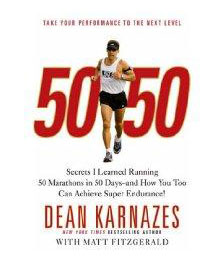 Dean Karnazes's latest book
Here are some tips from Dean:
Knowing when to say when
- "Live to fight another day"
Have not been running for a few days since i can't shake off my knee pain. Look like i going to abandon my marathon PB plan. Will start going to the pool for a swim.
Knowing when to say when
- "Live to fight another day"
- Never try to run through more than moderate pain in a muscle, bone or joint.
- Stop running whenever you experience dizziness, light-headedness, confusion, or blurred vision - all of which are symptoms of heat illness and severe dehydration.
- Don't try to continue training as normal when experiencing signs of over-training syndrome, including persistent fatigue, declining performance, lasting muscle soreness, and low motivation.
- Do not attempt to run when experiencing fever, flu-like symptoms, or other ailments, including diarrhea and food poisoning.
Have not been running for a few days since i can't shake off my knee pain. Look like i going to abandon my marathon PB plan. Will start going to the pool for a swim.
Sunday, October 26, 2008
Some info on Runner's Knee from Triathlete Mag
Read this article in the Triathlete Magazine on Runner's knee:
Beating Runner’s knee
By Matt Fitzgerald
Triathlete mag Oct 08
Patellofemoral pain syndrome-otherwise known as anterior knee pain and runner's knee is the most common running injury, accounting for roughly 20 percent of all running injuries. The main symptom is pain below the kneecap that is generally mild at first and experienced only during running but becomes progressively more intense during running and also increasingly felt at rest if training continues.
Many theories about the nature of the damage underlying the pain have come and gone. The reason behind this revolving door of proposed etiologies is that, unlike other injuries such as knee meniscus damage, there is no obvious structural abnormality associated with PFPS, whether the joined is examined by x-ray, MRI or surgical arthroscope. Recently this reality has led orthopedists to formulate a new view of PFPS in which pain itself or, more specifically, chronic stimulation of pain nerves in the knee is understood as the essence of the injury.
Any of a number of varieties of relatively minor tissue degradation, such as inflammation of the synovium, a pouch that contains the knee's lubricating fluid, may underlie this nerve stimulation. But because these breakdowns are relatively minor and hard to identify, they need not be targeted. It's the pain itself that must be targeted.
How do you target the pain? First, you avoid doing anything, including running, that causes the knee to hurt, but you also do as much running as you can do pain-free. This approach will enable the damaged tissues to restore homeostasis (or their natural equilibrium state of breakdown and regeneration) while keeping the knee well-adapted to the stress of running. Many runners with PFPS can do some pain-free running. You might find that you can run for a certain duration (say, 20 minutes) and no longer without pain. In this case, run only that far until your limit increases. Or you might find that you can run every other day, but not every day, without pain. Then run every other day for a while. After a few weeks, try a test run 24 hours after a previous run to see whether the limit remains. Continue to increase your running gradually back toward pre-injury levels as comfort allows, reversing this process briefly whenever soreness emerges anew.Where there is pain there is almost always inflammation.
Taking a non-steroidal anti-inflammatory medication such as ibuprofen according to label directions and placing an ice pack on your knee for 10 minutes at a time, three times a day, may accelerate the resolution of this inflammation.
Consider whether poor shoe selection, biomechanical factors, and/or muscle weakness might have contributed to your injury. Weakness in the hip abductors and hip external rotators is often seen in PFPS sufferers. In runners whose hip stabilizers are weak, the thigh tends to rotate internally as the foot comes into contact with the ground. This is a compensatory movement that is performed unconsciously to enable other muscles to take up the slack of stabilizing the pelvis. But the slack is not entirely picked up by these other muscles, and consequently the pelvis tilts laterally toward the ground on the side of the unsupported leg. The thigh tilts with it, like a falling tower, while the lower leg remains upright, pinching the knee between them. It is likely that this pinching effect, as well as the twisted (or "knock-kneed") position of the thigh relative to the knee when it absorbs impact forces, causes damage to occur within the joint. If you are a knock-kneed runner, train yourself to actively contract the muscles on the outside of your hips when you run to keep your pelvis level and keep those thighs in their natural, neutral alignment.
It is possible that pronounced heel striking, or over-striding, also increases the risk for PFPS. While this link has not been shown directly, studies have demonstrated that runners who experience excessive impact shock are more likely to develop PFPS, and that heel strikers experience greater impact shock than heel strikers. So if you are a pronounced heel striker and you have PFPS, training yourself to shorten your stride and land your foot flat underneath your hips instead of heel-first out in front of your body.
If reducing impact shock is an effective means of reducing the risk for PFPS, then switching to running shoes that reduce impact shock may also protect the knees. The problem is that research on the relationship between shoe cushioning and impact shock has produced muddled results. Some studies have found that impact forces are actually greater in running shoes with softer cushioning due to unconscious stride changes that are made in different shoes. However, it has been suggested that such counterintuitive results may have been caused by inadequate measurement techniques.
At least one recent study provides evidence that added shoe cushioning reduces specific impact variables that are now seen as the best indicators of injury risk-namely, peak loading rate (the abruptness of impact) and tibial acceleration rate (or the rate at which the lower leg approaches the ground). However, it still seems to be the case that interaction between the specific shoe and the individual runner has a major effect on impact characteristics, such that the right level of cushioning is different for each runner and it's impossible to predict the level that is right for any single runner.
Since you can't undergo comprehensive impact testing when shopping for running shoes, how do you select the shoe with th right amount of cushioning to minimize your risk of developing PFPS and other injuries? Some research indicates that comfort is a fairly reliable guide. Subjective assessments of comfort coupled with on-the-road experience are even better. To begin, buy and wear the most comfortable shoe you can find. If it keep you injury-free, buy another pair. If you do get injured in that shoe, try a different shoe with a little more or less cushioning that is also very comfortable. Keep experimenting with different shoes until you find your optimal shoe type (but keep in min that even the optimal shoe will not prevent all injuries).
Beating Runner’s knee
By Matt Fitzgerald
Triathlete mag Oct 08
Patellofemoral pain syndrome-otherwise known as anterior knee pain and runner's knee is the most common running injury, accounting for roughly 20 percent of all running injuries. The main symptom is pain below the kneecap that is generally mild at first and experienced only during running but becomes progressively more intense during running and also increasingly felt at rest if training continues.
Many theories about the nature of the damage underlying the pain have come and gone. The reason behind this revolving door of proposed etiologies is that, unlike other injuries such as knee meniscus damage, there is no obvious structural abnormality associated with PFPS, whether the joined is examined by x-ray, MRI or surgical arthroscope. Recently this reality has led orthopedists to formulate a new view of PFPS in which pain itself or, more specifically, chronic stimulation of pain nerves in the knee is understood as the essence of the injury.
Any of a number of varieties of relatively minor tissue degradation, such as inflammation of the synovium, a pouch that contains the knee's lubricating fluid, may underlie this nerve stimulation. But because these breakdowns are relatively minor and hard to identify, they need not be targeted. It's the pain itself that must be targeted.
How do you target the pain? First, you avoid doing anything, including running, that causes the knee to hurt, but you also do as much running as you can do pain-free. This approach will enable the damaged tissues to restore homeostasis (or their natural equilibrium state of breakdown and regeneration) while keeping the knee well-adapted to the stress of running. Many runners with PFPS can do some pain-free running. You might find that you can run for a certain duration (say, 20 minutes) and no longer without pain. In this case, run only that far until your limit increases. Or you might find that you can run every other day, but not every day, without pain. Then run every other day for a while. After a few weeks, try a test run 24 hours after a previous run to see whether the limit remains. Continue to increase your running gradually back toward pre-injury levels as comfort allows, reversing this process briefly whenever soreness emerges anew.Where there is pain there is almost always inflammation.
Taking a non-steroidal anti-inflammatory medication such as ibuprofen according to label directions and placing an ice pack on your knee for 10 minutes at a time, three times a day, may accelerate the resolution of this inflammation.
Consider whether poor shoe selection, biomechanical factors, and/or muscle weakness might have contributed to your injury. Weakness in the hip abductors and hip external rotators is often seen in PFPS sufferers. In runners whose hip stabilizers are weak, the thigh tends to rotate internally as the foot comes into contact with the ground. This is a compensatory movement that is performed unconsciously to enable other muscles to take up the slack of stabilizing the pelvis. But the slack is not entirely picked up by these other muscles, and consequently the pelvis tilts laterally toward the ground on the side of the unsupported leg. The thigh tilts with it, like a falling tower, while the lower leg remains upright, pinching the knee between them. It is likely that this pinching effect, as well as the twisted (or "knock-kneed") position of the thigh relative to the knee when it absorbs impact forces, causes damage to occur within the joint. If you are a knock-kneed runner, train yourself to actively contract the muscles on the outside of your hips when you run to keep your pelvis level and keep those thighs in their natural, neutral alignment.
It is possible that pronounced heel striking, or over-striding, also increases the risk for PFPS. While this link has not been shown directly, studies have demonstrated that runners who experience excessive impact shock are more likely to develop PFPS, and that heel strikers experience greater impact shock than heel strikers. So if you are a pronounced heel striker and you have PFPS, training yourself to shorten your stride and land your foot flat underneath your hips instead of heel-first out in front of your body.
If reducing impact shock is an effective means of reducing the risk for PFPS, then switching to running shoes that reduce impact shock may also protect the knees. The problem is that research on the relationship between shoe cushioning and impact shock has produced muddled results. Some studies have found that impact forces are actually greater in running shoes with softer cushioning due to unconscious stride changes that are made in different shoes. However, it has been suggested that such counterintuitive results may have been caused by inadequate measurement techniques.
At least one recent study provides evidence that added shoe cushioning reduces specific impact variables that are now seen as the best indicators of injury risk-namely, peak loading rate (the abruptness of impact) and tibial acceleration rate (or the rate at which the lower leg approaches the ground). However, it still seems to be the case that interaction between the specific shoe and the individual runner has a major effect on impact characteristics, such that the right level of cushioning is different for each runner and it's impossible to predict the level that is right for any single runner.
Since you can't undergo comprehensive impact testing when shopping for running shoes, how do you select the shoe with th right amount of cushioning to minimize your risk of developing PFPS and other injuries? Some research indicates that comfort is a fairly reliable guide. Subjective assessments of comfort coupled with on-the-road experience are even better. To begin, buy and wear the most comfortable shoe you can find. If it keep you injury-free, buy another pair. If you do get injured in that shoe, try a different shoe with a little more or less cushioning that is also very comfortable. Keep experimenting with different shoes until you find your optimal shoe type (but keep in min that even the optimal shoe will not prevent all injuries).
Wednesday, October 22, 2008
Standard Chartered Singapore Marathon Workshop Series IV - 1st Nov 2008
Has been very busy with my injury, may have to abandon my plan for the coming marathon PB.
Nevertheless, i received this mail regarding to the fourth and final series of the Singapore Marathon Workshop:
Dear Participants,
Thank you very much for your registration for SCSM Workshop Series IV - Tapering for Race Day!
Kindly REPLY to this email to confirm your attendance & registration, by Wednesday 29th Oct.
As we have a long waiting list of participants wanting to attend this workshop, a non-reply assumes that you will not be attending.
Hence, your spot will be opened to another participant who is able to attend.
The workshop begins promptly at 3pm. All participants are to be seated by 2:50pm. Your co-operation is much appreciated.
Programme for the Day (3 to 5pm):
1. Why is tapering important? When does one tapper and how? Carbo-loading when and how? By Mr Mohammed Azhar representing adidas Singapore
2. adidas athlete ~ What are the personal do’s and don’ts for some athletes on race day? And critical do’s and don’ts for race day. By Dr Tan Swee Kheng from Fifth Ray Integrated Activities
3. Tracking your progress & Practical session of creating a race check list. By Dr Tan Swee Kheng from Fifth Ray Integrated Activities
Please remember to bring your own writing materials (pen/pencil and paper).
See you all on Saturday, 1st November!
Take good care and have a wonderful week ahead!
Running with you,
Dr Tan Swee Kheng
Kinesiologist, Movement Specialist
FifthRay's Blog! http://fifthray.blogspot.com
Nevertheless, i received this mail regarding to the fourth and final series of the Singapore Marathon Workshop:
Dear Participants,
Thank you very much for your registration for SCSM Workshop Series IV - Tapering for Race Day!
Kindly REPLY to this email to confirm your attendance & registration, by Wednesday 29th Oct.
As we have a long waiting list of participants wanting to attend this workshop, a non-reply assumes that you will not be attending.
Hence, your spot will be opened to another participant who is able to attend.
The workshop begins promptly at 3pm. All participants are to be seated by 2:50pm. Your co-operation is much appreciated.
Programme for the Day (3 to 5pm):
1. Why is tapering important? When does one tapper and how? Carbo-loading when and how? By Mr Mohammed Azhar representing adidas Singapore
2. adidas athlete ~ What are the personal do’s and don’ts for some athletes on race day? And critical do’s and don’ts for race day. By Dr Tan Swee Kheng from Fifth Ray Integrated Activities
3. Tracking your progress & Practical session of creating a race check list. By Dr Tan Swee Kheng from Fifth Ray Integrated Activities
Please remember to bring your own writing materials (pen/pencil and paper).
See you all on Saturday, 1st November!
Take good care and have a wonderful week ahead!
Running with you,
Dr Tan Swee Kheng
Kinesiologist, Movement Specialist
FifthRay's Blog! http://fifthray.blogspot.com
Friday, September 19, 2008
Marathon Runners Have Higher Heart Risks ?
Check out this new from the REDORBIT
REDORBIT NEWS
Marathon Runners Have Higher Heart Risks Posted on: Wednesday, 17 September 2008, 08:00
CDT New research found older marathon runners may have an increased chance of suffering a heart attack.
Researchers found in a study of male marathoners age 50 and up the runners were as likely as other men their age to have calcium buildup in their heart arteries.When compared with men who had a similar amount of heart disease risk factors, marathoners actually tended to have more calcium in their arteries.Calcium is a component of artery-clogging plaques, and predicts a greater risk of suffering a heart attack.
Regular exercise is a heart-healthy habit, so it’s not clear why marathoners would have calcium scores similar to those of other men their age. In general, marathoners were found to have fewer traditional risk factors for heart disease; they weighed less, had lower "bad" LDL cholesterol, higher "good" HDL cholesterol and lower blood pressure.
This could mean that marathon running itself contributes to calcium buildup in some, according to study leader Dr. Stefan Mohlenkamp, of the West-German Heart Center Essen."Based on published data on the benefits of regular exercise, this possibility seems unlikely," he said.
Mohlenkamp said the answer may be found in the former unhealthy lifestyles of some of the runners in his study. Many, he noted, had only started serious, competitive running in their 40s, and half were former smokers.
Mohlenkamp noted that as a general rule, running is a good thing. "You live longer, you live better," he said. "Our study does not question at all the proven benefits of regular exercise."The study is published in the European Heart Journal.
Researchers recruited 108 apparently healthy male marathoners age 50 and older. They calculated each man's Framingham Risk Score -- a standard measure that doctors use to estimate a person's risk of having a heart attack in the next 10 years. It is based on age, sex, blood pressure, cholesterol and smoking habits.
The researchers also used CT scans to calculate each runner's coronary calcium score, and then compared the marathoners with a group of men who had taken part in another study.Overall, 13 percent of the marathoners had a calcium score above 400, which indicates a large of amount of plaque in the arteries.
Twenty-three percent had scores showing moderate plaque buildup. Those rates were nearly identical to those of the comparison group.
Mohlenkamp said doctors should get a detailed risk factor history for patients, and check whether the patient has ever had high blood pressure or has ever been overweight.
Mohlenkamp said that when it comes to judging whether it's safe for an older adult to exercise at such levels, it is "prudent" to not rely on their current risk factors alone.
REDORBIT NEWS
Marathon Runners Have Higher Heart Risks Posted on: Wednesday, 17 September 2008, 08:00
CDT New research found older marathon runners may have an increased chance of suffering a heart attack.
Researchers found in a study of male marathoners age 50 and up the runners were as likely as other men their age to have calcium buildup in their heart arteries.When compared with men who had a similar amount of heart disease risk factors, marathoners actually tended to have more calcium in their arteries.Calcium is a component of artery-clogging plaques, and predicts a greater risk of suffering a heart attack.
Regular exercise is a heart-healthy habit, so it’s not clear why marathoners would have calcium scores similar to those of other men their age. In general, marathoners were found to have fewer traditional risk factors for heart disease; they weighed less, had lower "bad" LDL cholesterol, higher "good" HDL cholesterol and lower blood pressure.
This could mean that marathon running itself contributes to calcium buildup in some, according to study leader Dr. Stefan Mohlenkamp, of the West-German Heart Center Essen."Based on published data on the benefits of regular exercise, this possibility seems unlikely," he said.
Mohlenkamp said the answer may be found in the former unhealthy lifestyles of some of the runners in his study. Many, he noted, had only started serious, competitive running in their 40s, and half were former smokers.
Mohlenkamp noted that as a general rule, running is a good thing. "You live longer, you live better," he said. "Our study does not question at all the proven benefits of regular exercise."The study is published in the European Heart Journal.
Researchers recruited 108 apparently healthy male marathoners age 50 and older. They calculated each man's Framingham Risk Score -- a standard measure that doctors use to estimate a person's risk of having a heart attack in the next 10 years. It is based on age, sex, blood pressure, cholesterol and smoking habits.
The researchers also used CT scans to calculate each runner's coronary calcium score, and then compared the marathoners with a group of men who had taken part in another study.Overall, 13 percent of the marathoners had a calcium score above 400, which indicates a large of amount of plaque in the arteries.
Twenty-three percent had scores showing moderate plaque buildup. Those rates were nearly identical to those of the comparison group.
Mohlenkamp said doctors should get a detailed risk factor history for patients, and check whether the patient has ever had high blood pressure or has ever been overweight.
Mohlenkamp said that when it comes to judging whether it's safe for an older adult to exercise at such levels, it is "prudent" to not rely on their current risk factors alone.
Story from REDORBIT NEWS:
http://www.redorbit.com/news/display/?id=1558193
Published: 2008/09/17 08:00:00 CDT
Thursday, September 18, 2008
Am i overtraining???
Was feeling sick after a gym workout + running on the previous day. Sore throat was the early symptom of my illness. Went to see a doctor and was diagnosed with common cold. I was thinking whether am i overtrained as i was increasing my weekly mileage. Hopefully not. By the way, i gotta some more information on overtraining from the book titled "The competitive Runner's handbook". Here are some of the overtraining symptoms:
- A loss in enthusiasm for training. A desire to quit or an unexplained poor performance in workouts or races .
- A sluggish feeling that lasts for several days. This usually starts with a few runs in which your pace is the same as usual, but it feels more difficult. Next comes "heavy legs." Now you're tired and slow. You have no zip in your step. You may think you're running 8-minute miles, but your watch says it's a 9-minute pace. Your ability to kick during speed workouts and races disappears
- A tired feeling after a full night of sleep. It may be difficult to get out of bed in the morning. You may also have difficulty falling asleep, or may wake up often in the night and find it difficult to go back to sleep. An occasional poor night's sleep should not be a concern, but if it persists for two or three nights, take notice.
- An increase in morning resting heart rate of ten beats or more for the average runner, or five or more for the highly trained competitor. Significant increases are a sign you are not fully recovered from the previous day or days of stress-whether from running or life.
- A pale, sallow, dejected look.
- More frequent or persistent colds, headaches, and respiratory infections. Minor cuts heal slowly. Swollen lymph glands. An early sign for me is a sore throat.
- Upset stomach, loss of appetite, sudden weight loss, constipation, or diarrhea.
- Mild tenderness or stiffness that doesn't go away after a day of rest or after the first few minutes of your daily run. Soreness for a day or two after hard runs is normal, but soreness that accumulates from high mileage or persists for several days after hard running isn't. Be aware of any indications that your musculoskeletal system has been overtaxed.
- Increased irritability, feelings of tension, short temper, mild depression, loss of confidence, difficulty making decisions, lack of concentration, poor coordination. Spouses are often the first to know when cranky mates are overtraining.
- An uncharacteristic lack of interest in running. This is often called "the blahs" or "burnout."
Friday, September 12, 2008
Sports Massage
Attended my first sports massage at SSMC. Targeted areas were my Quadriceps and ITB. It was the most painful massage i ever experienced, but i think it was worthwhile as i could feel my tight muscles loosen up. Will be going for sports massage once a month as to increase the chances of running injury-free.
What is Sports Massage?
What is Sports Massage?
Sports Massage is the term applied to the discipline of using massage for the specific benefit of all sports and exercise participants. It covers the management, manipulation and rehabilitation of the soft tissues of the body eg. muscles, ligaments and tendons.
Sports massage should be tailored to each individual's needs to positively enhance ones ability to perform.
Benefits of sports massage:
- Improve circulation & lymphatic flow
- Assist in the removal of metabolic waste
- Sedate or stimulate nerve endings
- Increase or decrease muscle tone
- Increase or decrease muscle length
- Remodel scar tissue when required
- Assist in mental preparation for sporting participation
Sports massage can be beneficial at various stages of participation. For example:
- The conditioning / training phase
- Pre competition
- Inter competition
- Post competition
- Post travel
- Injury prevention
- Injury recovery
Regardless of whether you exercise or play sport to keep fit, or compete from club to international level, then sports massage may have something to offer you.
http://www.pubmedcentral.nih.gov/articlerender.fcgi?artid=1320372

Mindmap of sport massage using imindmap software
Reference
Understanding Sports Massage (Paperback) by Patricia J., Ph.D. Benjamin (Author), Scott P. Lamp (Author)
Tuesday, August 12, 2008
What is Over Training?
Is my sudden increase in running intensity that contributed to my knee injury/strain? I am clueless in finding the cause of my knee injury/strain. Maybe it was due to the intervals training that i had just implemented in my running program for the Singapore marathon. Or am i over training? This boiled down to the understanding of over training.
Below are some of the abstracts of a seminar which i had attended long time ago:
Are You Over-Training?
By Dr Low Wye Mun
Do you love your sport? Are you working just as hard as you can to improve your performance? Hours of dedicated effort according to a carefully constructed training programme ... and yet, feeling as If things are just not quite right? Feeling a little lethargic, more tired than usual, and just needing much more effort to get going?
Well, you could have reached the point when your body is telling you that the effort you are putting in has out-stripped your resources. In a word, you may be over-training. In order to ensure that you stay in the bes1 physical and mental shape for your sports, read on and find out the what, why and how of this discouraging condition.
What is OVER-TRAINING ?
• As an athlete, you train in a way that shifts your body's daily physical state beyond its normal everyday level of functioning. Carefully regulated and controlled, such intensive demands made of your heart, lungs, muscles and joints become the training stimulus that allow you to reach towards improved performance.
• Occasionally, the amount of training you do (as measured by frequency, intensity and duration) may go beyond the body's ability to adapt to the stresses imposed. You may thus "over-reach." This may form part of your training and competition cycle, and provided that you have proper recovery from these episodes of over-reaching, your performance development will continue without much problems.
• For example, you may be taking part in the regular local cycling races as well as in regional races. If these races are outside of your normal pattern (e.g. your first ever 4-day tour race event), you physiologically reach further than ever before. If there is no let-up in training Of competition preparation after that event, your body does not have the chance to adapt and recover, and you risk entering into the zone of relative physical and mental overload called "over-training". This is one situation when more is better does not hold.
How do I know if have over-trained?
• The over-trained body responds with disturbances of several functions of the body including those of the nervous system, hormones and the immune system. While no two people will respond in exactly the same way, there is a general appearance of signs that things are not well. These can cause the active sports person to become quite depressed that their hard work is not resulting in improving performance.
• The trick to managing what can be a confusing and defeating period in your sports career is to recognize the signs that say you have over-trained. You may not have all of these signs, but if your exercise and sports performance is dropping. and you have some of the other symptoms listed, you may indeed have over-trained.
Signs and Symptoms of Over Training
Poor or decreased performance
Below are some of the abstracts of a seminar which i had attended long time ago:
Are You Over-Training?
By Dr Low Wye Mun
Do you love your sport? Are you working just as hard as you can to improve your performance? Hours of dedicated effort according to a carefully constructed training programme ... and yet, feeling as If things are just not quite right? Feeling a little lethargic, more tired than usual, and just needing much more effort to get going?
Well, you could have reached the point when your body is telling you that the effort you are putting in has out-stripped your resources. In a word, you may be over-training. In order to ensure that you stay in the bes1 physical and mental shape for your sports, read on and find out the what, why and how of this discouraging condition.
What is OVER-TRAINING ?
• As an athlete, you train in a way that shifts your body's daily physical state beyond its normal everyday level of functioning. Carefully regulated and controlled, such intensive demands made of your heart, lungs, muscles and joints become the training stimulus that allow you to reach towards improved performance.
• Occasionally, the amount of training you do (as measured by frequency, intensity and duration) may go beyond the body's ability to adapt to the stresses imposed. You may thus "over-reach." This may form part of your training and competition cycle, and provided that you have proper recovery from these episodes of over-reaching, your performance development will continue without much problems.
• For example, you may be taking part in the regular local cycling races as well as in regional races. If these races are outside of your normal pattern (e.g. your first ever 4-day tour race event), you physiologically reach further than ever before. If there is no let-up in training Of competition preparation after that event, your body does not have the chance to adapt and recover, and you risk entering into the zone of relative physical and mental overload called "over-training". This is one situation when more is better does not hold.
How do I know if have over-trained?
• The over-trained body responds with disturbances of several functions of the body including those of the nervous system, hormones and the immune system. While no two people will respond in exactly the same way, there is a general appearance of signs that things are not well. These can cause the active sports person to become quite depressed that their hard work is not resulting in improving performance.
• The trick to managing what can be a confusing and defeating period in your sports career is to recognize the signs that say you have over-trained. You may not have all of these signs, but if your exercise and sports performance is dropping. and you have some of the other symptoms listed, you may indeed have over-trained.
Signs and Symptoms of Over Training
Poor or decreased performance
- Loss of muscular strength
- Decline in endurance
- Drop in exercise capacity
- Decreased co-ordination
- Increased muscle fatigue
- Muscle soreness at lower levels of exercise, and persisting after exercise
- Raised heart rate (pulse) at rest and during exercise
- Loss of interest and drive to exercise
- Feelings of staleness & lethargy
- Loss of appetite & body weight loss
- Sleep disturbances
- Increased minor illnesses (e.g. sore throat, coughs, colds, allergic reactions)
Sunday, August 10, 2008
The Straits Times 090808 Get Hard-core
Missed the PI run series 2 this morning as i am nursing my knee injury. Had not been running for the past few days due to swelling in my knee. Nevertheless, the morning weather was almost perfect for a run as the skies were covered by clouds and the air was cooling.
Read the Saturday (090808) Straits Times which "talks" about building up Core muscles for running. Here are the abstracts from the articles "GET HARD-CORE" by Jeanette Wang :
WHEN it comes to running fast, it is what is inside that counts - literally.
While most runners will clock up miles conscientiously to improve their times, they tend to forget the importance of building a strong core.
Yet that is essential because it improves one's running economy and also reduces injury, says former Singapore Athletic Association senior consultant coach Guy Ogden.
In fact, it is a must before embarking on a training programme - not just for running but for any sport, notes the former European Masters 10 km road champion.
Think of it as building a house on a good foundation.
Core muscles are generally buried under other muscles, including those in your abdomen, back and hips.
A runner with weak core strength is physically unstable and runs inefficiently, such as having his upper body moving sideways, says Ogden, also an osteopath.
What's more, he is at greater risk of injury, because the body tries to compensate for these inefficiencies.
Ideally, rather than trying to stabilize these unnecessary movements, all the force a runner produces should go to-wards propelling him forward.
A strong core does the trick.
"Running inefficiently increases the demands on a runner's cardio system. Having a strong core gives you better running economy, so you use less oxygen to run at a given speed," says Ogden, who coached the Vietnam national athletics team in 2001 and 2003.
The best thing about this? You can reap the benefits of core conditioning just by spending 10 minutes on a few exercises before training.
These were developed by Kelvin Giles, who coached track and field athletes in Britain and Australia to the Olympics in the 1970s and 1980s.
Ogden's training group, Athlon Running - who include top Singapore marathoner Vivian Tang and ultra-marathon winner Fabian William - swear by the exercises before their warm-up jogs.
Here, Ogden demonstrates three static exercises : the bridge, the sit-up and the single-leg squat that activate the essential muscle groups needed for running.
By the way, Ogden, 64, who has a personal best of 2h 24min for the marathon, still competes and can knock out 19-minute 5km races with ease.
He is hard-core.Are you?
Single-leg static squat


THERE are two positions for this pose.In the high position, the thigh and calf of your grounded leg should form a nO-degree angle. In the tougher medium position, the angle should be 90 degrees.Your head should be up, chest up, back straight and butt out.Viewed from the front, your ankle, knee and hip should be aligned.Your free leg should be ahead of the body.
Hold each position, once on each leg, for 10 seconds at a time. The goal is to hold the position without any ankle, knee, hip or trunk distortion.Ensure that you give yourself plenty of recovery between, each position attempt.
The Bridge
 Supine Bridge
 Front Bridge
 Side Bridge
THE bridge is the basic building block of core'strength and stability work, says Ogden, It develops horizontal stability a prerequisite before 'one moves on to vertical stability.
Start off holding each pose for 30 sec-onds and build up to two minutes - a target that should take about three to four weeks to reach.
For all poses, your head should be in a neutral position, lower abdomen "drawn in", gluteus activated and shoulder blades retracted ("down and back").
Ensure that your body always forms a straight line. Your hips should not be too high or low and your back should not be rounded.
Begin in the front bridge position, with only forearms and toes touching the ground.
Next is the side bridge. Turn on your left side and support your body only with your left fore-arm and left foot.
Your support arm should be at 90 degrees to the body and your free arm by your side. Repeat on the other side.
The final pose is the supine bridge, where your body is facing up, with only your arms and feet on the ground.
Once you reach the target of two minutes for each exercise, you should take each pose to the next difficulty level, starting again at 30 seconds and building up to the target. Do the poses with straightened arms for a, tougher exercise. Then, lift one leg in the air for added difficulty. Finally, do the poses with your toes resting on an exercise ball instead of the ground for the ultimate challenge.
60-degree static sit-up

SIT with your knees bent and lean back, so that your back makes a 60-degree an¬gle with the ground.Your lower abdomen should be drawn in, shoulder blades drawn down, and arms kept across the chest.Ensure that your back is kept straight, not roun'ded, and your hips are up, rather than slumped.Hold the position for 30 seconds at first, then build up to two minutes.
"Running inefficiently increases the demands on a runner's cardio system. Having a strong core gives you better running economy, so you use less
oxygen to run..."
GUY OGDEN, former European Masters lOkm road champion and former Singapore Athletic Association senior consultant coach
Will be trying out all these exercises before my runs!
Read the Saturday (090808) Straits Times which "talks" about building up Core muscles for running. Here are the abstracts from the articles "GET HARD-CORE" by Jeanette Wang :
WHEN it comes to running fast, it is what is inside that counts - literally.
While most runners will clock up miles conscientiously to improve their times, they tend to forget the importance of building a strong core.
Yet that is essential because it improves one's running economy and also reduces injury, says former Singapore Athletic Association senior consultant coach Guy Ogden.
In fact, it is a must before embarking on a training programme - not just for running but for any sport, notes the former European Masters 10 km road champion.
Think of it as building a house on a good foundation.
Core muscles are generally buried under other muscles, including those in your abdomen, back and hips.
A runner with weak core strength is physically unstable and runs inefficiently, such as having his upper body moving sideways, says Ogden, also an osteopath.
What's more, he is at greater risk of injury, because the body tries to compensate for these inefficiencies.
Ideally, rather than trying to stabilize these unnecessary movements, all the force a runner produces should go to-wards propelling him forward.
A strong core does the trick.
"Running inefficiently increases the demands on a runner's cardio system. Having a strong core gives you better running economy, so you use less oxygen to run at a given speed," says Ogden, who coached the Vietnam national athletics team in 2001 and 2003.
The best thing about this? You can reap the benefits of core conditioning just by spending 10 minutes on a few exercises before training.
These were developed by Kelvin Giles, who coached track and field athletes in Britain and Australia to the Olympics in the 1970s and 1980s.
Ogden's training group, Athlon Running - who include top Singapore marathoner Vivian Tang and ultra-marathon winner Fabian William - swear by the exercises before their warm-up jogs.
Here, Ogden demonstrates three static exercises : the bridge, the sit-up and the single-leg squat that activate the essential muscle groups needed for running.
By the way, Ogden, 64, who has a personal best of 2h 24min for the marathon, still competes and can knock out 19-minute 5km races with ease.
He is hard-core.Are you?
Single-leg static squat


THERE are two positions for this pose.In the high position, the thigh and calf of your grounded leg should form a nO-degree angle. In the tougher medium position, the angle should be 90 degrees.Your head should be up, chest up, back straight and butt out.Viewed from the front, your ankle, knee and hip should be aligned.Your free leg should be ahead of the body.
Hold each position, once on each leg, for 10 seconds at a time. The goal is to hold the position without any ankle, knee, hip or trunk distortion.Ensure that you give yourself plenty of recovery between, each position attempt.
The Bridge
 Supine Bridge
 Front Bridge
 Side Bridge
THE bridge is the basic building block of core'strength and stability work, says Ogden, It develops horizontal stability a prerequisite before 'one moves on to vertical stability.
Start off holding each pose for 30 sec-onds and build up to two minutes - a target that should take about three to four weeks to reach.
For all poses, your head should be in a neutral position, lower abdomen "drawn in", gluteus activated and shoulder blades retracted ("down and back").
Ensure that your body always forms a straight line. Your hips should not be too high or low and your back should not be rounded.
Begin in the front bridge position, with only forearms and toes touching the ground.
Next is the side bridge. Turn on your left side and support your body only with your left fore-arm and left foot.
Your support arm should be at 90 degrees to the body and your free arm by your side. Repeat on the other side.
The final pose is the supine bridge, where your body is facing up, with only your arms and feet on the ground.
Once you reach the target of two minutes for each exercise, you should take each pose to the next difficulty level, starting again at 30 seconds and building up to the target. Do the poses with straightened arms for a, tougher exercise. Then, lift one leg in the air for added difficulty. Finally, do the poses with your toes resting on an exercise ball instead of the ground for the ultimate challenge.
60-degree static sit-up

SIT with your knees bent and lean back, so that your back makes a 60-degree an¬gle with the ground.Your lower abdomen should be drawn in, shoulder blades drawn down, and arms kept across the chest.Ensure that your back is kept straight, not roun'ded, and your hips are up, rather than slumped.Hold the position for 30 seconds at first, then build up to two minutes.
"Running inefficiently increases the demands on a runner's cardio system. Having a strong core gives you better running economy, so you use less
oxygen to run..."
GUY OGDEN, former European Masters lOkm road champion and former Singapore Athletic Association senior consultant coach
Will be trying out all these exercises before my runs!
Tuesday, August 5, 2008
Recovery from exercising
Has been feeling very tired after work and the tiredness had prevented me from running efficiently. Something has to be done or else this fatigue feeling will jeopardize my AHM race, which i am gunning a timing of under 1hr 55 mins. I recalled that one of the seminars that i attended, talked about the art & science of Recovery.
Here are the abstracts of the seminar :
The Art & Science of Recovery
What is RECOVERY?
• Exercise at all levels of intensity acts to do one thing to the body: it depletes it. The depletion includes your energy stores (muscle glycogen, blood glucose and fat products in your blood), hormones, and muscle structures. In other words, you use up the body's valuable exercise resources.
• In order to return to training and to continue conditioning your body to meet your exercise goals, it is important to create time and take active steps to bring about a re-building of the depleted body resources. This is what recovery is all about. This is especially important if you are intending to exercise intensively or for long durations soon after an exhausting bout. This could be a multi-stage bike race, or triathlon competitions that are only 2-4 weeks apart (e.g. the Port Dickson tri less than 3 weeks after the OSIM event).
Why bother with it ?
• In the very simplest terms, to keep you physically exercising at the level that you want to. Even more importantly, to allow the body's systems to re-charge sufficiently that your mental edge remains honed to that fine sharpness you desire. A blunted edge comes about from insufficient- recovery and can come back to haunt you in these ways: staleness, loss of interest, reduced physical ability, decreased exercise tolerance. Yes indeed, the first steps towards over-training.
• A good approach to recovery will ensure that the quality of your training and competition is high. This will contribute to you feeling satisfied with your efforts and achievements, and bring about continued confidence in your chosen endurance sport. Good recovery also enables you to exert greater overall sense of control of your exercise destiny.
When should I think about this ?
• You should consider recovery at both macro- and micro-levels. An example of a macro level would be a period of training preparation time (e.g. a week or month), or the period between competitions on your race calendar. A micro-level consideration would be after a single very or exhaustive workout.
• At the macro level, the depletion of resources has arisen as a systematic and progressive wearing away that parallels your rigorously planned training program. It is not the single mind-blowing training session that is involved here but rather the accumulated effect of all the sessions combined, and possibly inclusive of the race.
• The micro recovery level answers the body's aching need following that supremely challenging training session, back-to-back training sessions in some training camp, or the actual huge effort put into the competitive event
What are the steps i should take to recover properly?
• First of all, ensure that you take account of your macro and micro needs. Maintain an awareness of these using a training/race calendar that allows you to visually assess the cycles you are going through. Akin to the periodisation approach to training, this will help you to plan for recovery periods and make these a part of your training plan.
• Now consider the elements of the recovery: nutrition, structure regeneration, inflammation reduction, hormonal, and mental.
• Nutrition involves replacing the resources that you have used up in your prodigious attempts to go faster and stronger. This includes particular emphasis on replacing the following nutritional depletions: carbohydrates to re-build muscle glycogen, and minerals and electrolytes (from sweat loss). The best time to re-build glycogen stores is within the first 3 hours after exercise as this is when the rate of glycogen storage is highest. Such storage remains elevated in the next 21 hours but not at the same rate as what has been called the "critical re-energizing window."
• For some of athletes, there are barriers to be overcome to meet this immediate post-exercise nutrition need. This includes not feeling hungry or not having the correct nutrition available. Positive steps must be taken to overcome these. Have nutrition available. If you can't stomach eating (another intended pun), then drink your nutrition (energy drinks, carbohydrate mixes).
• If you are quite lean (meaning your body fat content is low), you should also ensure that your energy replacement includes a balanced diet that has FAT and protein in it. Your overall energy needs are higher than someone who has not discovered triathlons yet. So meet your higher energy needs and balance the sources of your energy: about 50-60 % from carbohydrates, 15 % from protein, and up to 30% from fat.
• 'Reducing your physical exercise is a good idea for 4-5 days after that punishing race. This does not mean just lying around doing nothing, although that may be the order of the first day or so after completing. You will want to spend time actively stretching those tired and tight muscles, and by the 4th or 5th day, a light spin on the bike or some easy laps will help to keep your mind happy while you rest the muscles, tendons, joints and bones of your body. This is what is called "relative rest" with components of "active recovery".
• The recovery period is a useful time to catch up with equipment maintenance matters. And in the tong run, these really do matter. Clean the saltwater out of your running shoes, wash your bike and lake it to the shop for tune-up if needed. Wash those hard-worn heart rate monitor straps.
• And finally, there is massage. Do i detect some glee out-there? The aim of massage to tired aching muscles is to relieve the tension that has built up in the muscles, as well as to assist in the removal of chemical substances that build up during exercise or as a result of cell activity during exercise. So just as top cycling teams bring their own masseuses to races (especially cycling tour competitions), you can help your body along with some judiciously administered massage.
Recovery is something you should invest your effort into as much as you do your training preparations. It is an integral part of restoring your body to a condition which allows you to enjoy regular and continuous challenging training and competition.
After going through all this informations, i felt sleepy z z z z z z ......
Here are the abstracts of the seminar :
The Art & Science of Recovery
What is RECOVERY?
• Exercise at all levels of intensity acts to do one thing to the body: it depletes it. The depletion includes your energy stores (muscle glycogen, blood glucose and fat products in your blood), hormones, and muscle structures. In other words, you use up the body's valuable exercise resources.
• In order to return to training and to continue conditioning your body to meet your exercise goals, it is important to create time and take active steps to bring about a re-building of the depleted body resources. This is what recovery is all about. This is especially important if you are intending to exercise intensively or for long durations soon after an exhausting bout. This could be a multi-stage bike race, or triathlon competitions that are only 2-4 weeks apart (e.g. the Port Dickson tri less than 3 weeks after the OSIM event).
Why bother with it ?
• In the very simplest terms, to keep you physically exercising at the level that you want to. Even more importantly, to allow the body's systems to re-charge sufficiently that your mental edge remains honed to that fine sharpness you desire. A blunted edge comes about from insufficient- recovery and can come back to haunt you in these ways: staleness, loss of interest, reduced physical ability, decreased exercise tolerance. Yes indeed, the first steps towards over-training.
• A good approach to recovery will ensure that the quality of your training and competition is high. This will contribute to you feeling satisfied with your efforts and achievements, and bring about continued confidence in your chosen endurance sport. Good recovery also enables you to exert greater overall sense of control of your exercise destiny.
When should I think about this ?
• You should consider recovery at both macro- and micro-levels. An example of a macro level would be a period of training preparation time (e.g. a week or month), or the period between competitions on your race calendar. A micro-level consideration would be after a single very or exhaustive workout.
• At the macro level, the depletion of resources has arisen as a systematic and progressive wearing away that parallels your rigorously planned training program. It is not the single mind-blowing training session that is involved here but rather the accumulated effect of all the sessions combined, and possibly inclusive of the race.
• The micro recovery level answers the body's aching need following that supremely challenging training session, back-to-back training sessions in some training camp, or the actual huge effort put into the competitive event
What are the steps i should take to recover properly?
• First of all, ensure that you take account of your macro and micro needs. Maintain an awareness of these using a training/race calendar that allows you to visually assess the cycles you are going through. Akin to the periodisation approach to training, this will help you to plan for recovery periods and make these a part of your training plan.
• Now consider the elements of the recovery: nutrition, structure regeneration, inflammation reduction, hormonal, and mental.
• Nutrition involves replacing the resources that you have used up in your prodigious attempts to go faster and stronger. This includes particular emphasis on replacing the following nutritional depletions: carbohydrates to re-build muscle glycogen, and minerals and electrolytes (from sweat loss). The best time to re-build glycogen stores is within the first 3 hours after exercise as this is when the rate of glycogen storage is highest. Such storage remains elevated in the next 21 hours but not at the same rate as what has been called the "critical re-energizing window."
• For some of athletes, there are barriers to be overcome to meet this immediate post-exercise nutrition need. This includes not feeling hungry or not having the correct nutrition available. Positive steps must be taken to overcome these. Have nutrition available. If you can't stomach eating (another intended pun), then drink your nutrition (energy drinks, carbohydrate mixes).
• If you are quite lean (meaning your body fat content is low), you should also ensure that your energy replacement includes a balanced diet that has FAT and protein in it. Your overall energy needs are higher than someone who has not discovered triathlons yet. So meet your higher energy needs and balance the sources of your energy: about 50-60 % from carbohydrates, 15 % from protein, and up to 30% from fat.
• 'Reducing your physical exercise is a good idea for 4-5 days after that punishing race. This does not mean just lying around doing nothing, although that may be the order of the first day or so after completing. You will want to spend time actively stretching those tired and tight muscles, and by the 4th or 5th day, a light spin on the bike or some easy laps will help to keep your mind happy while you rest the muscles, tendons, joints and bones of your body. This is what is called "relative rest" with components of "active recovery".
• The recovery period is a useful time to catch up with equipment maintenance matters. And in the tong run, these really do matter. Clean the saltwater out of your running shoes, wash your bike and lake it to the shop for tune-up if needed. Wash those hard-worn heart rate monitor straps.
• And finally, there is massage. Do i detect some glee out-there? The aim of massage to tired aching muscles is to relieve the tension that has built up in the muscles, as well as to assist in the removal of chemical substances that build up during exercise or as a result of cell activity during exercise. So just as top cycling teams bring their own masseuses to races (especially cycling tour competitions), you can help your body along with some judiciously administered massage.
Recovery is something you should invest your effort into as much as you do your training preparations. It is an integral part of restoring your body to a condition which allows you to enjoy regular and continuous challenging training and competition.
After going through all this informations, i felt sleepy z z z z z z ......
Monday, July 28, 2008
Our body Sweat ......
The body has a built in temperature regulator, and it function to keep our body temperature constantly on 36 to 37 degree Celsius. Our body perspiration increases in proportional to our body temperature as to keep our internal body temperature level.
Do you know that it is the vaporization of our sweat that ensures the cooling of our body and NOT the sweat secretion?Sweating cools the body - 4 ounces of sweat prevents a 1 degree rise in body temperature. Sweat consists mostly of water, but it also include other nutrients like sodium, chloride and potassium. Our sweat vaporization is influenced by external temperature (Ambient temperature), and the humidity of the air (amount of water vapor in a sample of air).
Sweat vaporization in warm and dry weather will cause cooling of our body sooner than in warm and wet weather. Our body temperature will also increases more in warm than in cool weather. An increment in body temperature will cause overheating, which can lead to heat cramps, heat exhaustion and heat stroke. Click here to find out more in heat sickness from my previous post.
Sweating is good for us as it cools our body, but it is also bad for us if we lose too much water. If our body fluid is not replaced, we will get dehydrated. Dehydration impairs our performance and increases risk of heart problems. One way to know whether we have sufficiently replaced lost fluids is to check our urine color and frequency. A good flow of clear or pale yellow urine is a good indication of sufficient fluids. Dark or reduced urine indicates the need to replace fluids.
Remember to drink plenty of fluids before, during and after a run.
Run to here to find out more in how sweats work.
Do you know that it is the vaporization of our sweat that ensures the cooling of our body and NOT the sweat secretion?Sweating cools the body - 4 ounces of sweat prevents a 1 degree rise in body temperature. Sweat consists mostly of water, but it also include other nutrients like sodium, chloride and potassium. Our sweat vaporization is influenced by external temperature (Ambient temperature), and the humidity of the air (amount of water vapor in a sample of air).
Sweat vaporization in warm and dry weather will cause cooling of our body sooner than in warm and wet weather. Our body temperature will also increases more in warm than in cool weather. An increment in body temperature will cause overheating, which can lead to heat cramps, heat exhaustion and heat stroke. Click here to find out more in heat sickness from my previous post.
Sweating is good for us as it cools our body, but it is also bad for us if we lose too much water. If our body fluid is not replaced, we will get dehydrated. Dehydration impairs our performance and increases risk of heart problems. One way to know whether we have sufficiently replaced lost fluids is to check our urine color and frequency. A good flow of clear or pale yellow urine is a good indication of sufficient fluids. Dark or reduced urine indicates the need to replace fluids.
Remember to drink plenty of fluids before, during and after a run.
Run to here to find out more in how sweats work.
Saturday, July 26, 2008
Inspirations from elderly
Recently, i came across The Straits Times newspaper supplement "Mind your body" which covered the topic on "Growing old, staying active". The author published an article on maintaining health as Singaporeans' life expectancy increases. The article also includes elderly mens' interview. Two of the interviewee gives me some inspirations in running. Below are the abstracts of the two interview taken from the newspaper:
 Mr Chan Meng Hui,78 (Photo from The Straits Times)
It is a miracle that Mr Chan Meng Hui is still alive. The self-confessed "naughty boy" used to smoke one to two packets of cigarettes a day and he drank heavily every night.
It was only after he retired from his job as an insurance executive when he was 55 years old that he decided to turn his life around.
The 78-year-old, who now runs a courier service business', 'Said: "It's whether you treasure your life or not. I've seen so many friends die after retirement. I had 10 or 12 drinking kakis who are all gone.
Mr Chan discovered the joys of' running after retirement and promptly got hooked.
When he turned 56, he ran his first marathon. Since then, he has taken part in 76 marathons around the world in countries like Norway, Japan, China and Switzerland.
He runs at least 7km after work everyday and meets his friends from running club MR25 at MacRitchie Reservoir every Sunday morning for 25km run. He said: "My target is to run 100 marathons."
Besides running, he also keeps and himself busy with community choir practice and managing his courier business. He said: "I don't even have time for to watch TV. I'm so busy that every a week passes very fast."
 Mr Richard Khoo, 84 (Photo from The Straits Times)
Now he spends more time running after his wife, Lily, 80, who has Alzheimer's disease and is prone to wandering off.
Mr Khoo said: "1 don't run much now because I've to take care of Lily. I want her to come running with me but she's been lost three times." He added: "People in our neighbourhood now help me watch out for her."
The former civil servant has taken part in 44 marathons around the world, including runs in Japan, South Korea and Malaysia. He will attempt the Standard Chartered Singapore Marathon this year.
He only started running at the age of 55 after he retired. He said: "Before i turned 55, r was working all the time. I swam but not regularly and I wasn't very active."
His son, Alan, now 54, introduced him to running. Mr Khoo said: "He took me to the National Stadium to show me people of all ages running. He also bought me a pair of running shoes."
Mr Khoo armed himself with a stopwatch and has never stopped to catch his breath since. He said: "The best marathon I've done was in Melbourne, where 1 did 42km under five hours. I run better in colder climates."
He is maniacal about health these days, popping garlic, gingko and omega-3 fish oil pills every day to give his body a boost.
Breakfast is a hearty mix of cereal, coarse rice powder, wheatgerm, cheese and water. He skips lunch and dinner, preferring to "eat only when my body needs it".
Asked why exercise is important for the elderly, he said: "It's important to keep physically active even when you're older. Without that, you'll have health problems."
However, Mrs Khoo's condition has taken a toll on him in recent months. His last medical check-up in June showed that his blood pressure had shot up and that he had developed diabetes. He now takes medication to control his blood sugar levels.
Although he has stopped running regularly, he is confident that he will be able to complete the Standard Chartered Singapore Marathon in December.
He said: "I should be able to pace myself and run it at a relaxing pace."
He plans to keep within an average time of running 1km in 13 to 14 minutes.
He added: "I'll be running marathons until the end of time."
The articles also mentioned about five behaviours in elderly men that are associated with living long and well. According to Dr Laurel Yates, a geriatrician, elderly men should:
 Mr Chan Meng Hui,78 (Photo from The Straits Times)
It is a miracle that Mr Chan Meng Hui is still alive. The self-confessed "naughty boy" used to smoke one to two packets of cigarettes a day and he drank heavily every night.
It was only after he retired from his job as an insurance executive when he was 55 years old that he decided to turn his life around.
The 78-year-old, who now runs a courier service business', 'Said: "It's whether you treasure your life or not. I've seen so many friends die after retirement. I had 10 or 12 drinking kakis who are all gone.
Mr Chan discovered the joys of' running after retirement and promptly got hooked.
When he turned 56, he ran his first marathon. Since then, he has taken part in 76 marathons around the world in countries like Norway, Japan, China and Switzerland.
He runs at least 7km after work everyday and meets his friends from running club MR25 at MacRitchie Reservoir every Sunday morning for 25km run. He said: "My target is to run 100 marathons."
Besides running, he also keeps and himself busy with community choir practice and managing his courier business. He said: "I don't even have time for to watch TV. I'm so busy that every a week passes very fast."
 Mr Richard Khoo, 84 (Photo from The Straits Times)
Mr Richard Khoo misses running.The 84-year-old retiree used to run at least 10km every day.
Now he spends more time running after his wife, Lily, 80, who has Alzheimer's disease and is prone to wandering off.
Mr Khoo said: "1 don't run much now because I've to take care of Lily. I want her to come running with me but she's been lost three times." He added: "People in our neighbourhood now help me watch out for her."
The former civil servant has taken part in 44 marathons around the world, including runs in Japan, South Korea and Malaysia. He will attempt the Standard Chartered Singapore Marathon this year.
He only started running at the age of 55 after he retired. He said: "Before i turned 55, r was working all the time. I swam but not regularly and I wasn't very active."
His son, Alan, now 54, introduced him to running. Mr Khoo said: "He took me to the National Stadium to show me people of all ages running. He also bought me a pair of running shoes."
Mr Khoo armed himself with a stopwatch and has never stopped to catch his breath since. He said: "The best marathon I've done was in Melbourne, where 1 did 42km under five hours. I run better in colder climates."
He is maniacal about health these days, popping garlic, gingko and omega-3 fish oil pills every day to give his body a boost.
Breakfast is a hearty mix of cereal, coarse rice powder, wheatgerm, cheese and water. He skips lunch and dinner, preferring to "eat only when my body needs it".
Asked why exercise is important for the elderly, he said: "It's important to keep physically active even when you're older. Without that, you'll have health problems."
However, Mrs Khoo's condition has taken a toll on him in recent months. His last medical check-up in June showed that his blood pressure had shot up and that he had developed diabetes. He now takes medication to control his blood sugar levels.
Although he has stopped running regularly, he is confident that he will be able to complete the Standard Chartered Singapore Marathon in December.
He said: "I should be able to pace myself and run it at a relaxing pace."
He plans to keep within an average time of running 1km in 13 to 14 minutes.
He added: "I'll be running marathons until the end of time."
The articles also mentioned about five behaviours in elderly men that are associated with living long and well. According to Dr Laurel Yates, a geriatrician, elderly men should:
- Abstain from smoking
- Manage their weight
- Control their blood pressure
- Avoid diabetes
- Exercise regularly
Tuesday, July 22, 2008
Injury Prevention Performance Improvement Plan
Here are some more of the running seminar informations that i had shared earlier.
"Here's a 4-Step Injury Prevention Performance Improvement Plan that can help you or members of your sports team reduce your chance of getting injured, and in so doing, save your time and 'money while increasing your enjoyment of your favorite activities.
Step 1 : Have a proper review done.
"Here's a 4-Step Injury Prevention Performance Improvement Plan that can help you or members of your sports team reduce your chance of getting injured, and in so doing, save your time and 'money while increasing your enjoyment of your favorite activities.
Step 1 : Have a proper review done.
- See your sports doctor or sports physiotherapist and have a professional assessment of your injury risk factors. Particular attention should be given to any current or past injuries that interfere with your activity either because of pain, weakness, or instability.
- This assessment will aim to put into place a series of exercises that specifically address your injury risk factors. These exercises include specific stretching of tight muscles and tendons, strengthening of certain muscles, and balancing your joint movements and muscles. The aim of the exercises (which may seem very simple at first) is not only to prevent injuries, but also to improve your performance of exercise or sports skills.
- These prevention-performance exercises should then be made a part of your physical preparation for your activity or sport. For sports which are played during certain competitive seasons, or for activities which you are preparing for (e.g. your first half-marathon, or the annual triathlon race), the injury risk factor review will help you to plan when you should focus on these exercises as part of your schedule. Typically, the off-season is a great time to be reviewed and to start' prevention performance work in preparation for the next season.
- For most exercise and sports, the most crucial piece of equipment is your shoes. If you followed the advice for Step 1, part of your review will include an assessment of your feet what shape they are, what shape they are in, what problems you may have (and some which you may not be aware of ), and how your current sports shoes perform for your toot type. Advice on the right type of shoes or perhaps supportive insoles can then lead to a lowering of your injury risk, less aches and pain, and better performance.
- Other equipment choices are dependent on your injuries you may have already. Changing the grip size of your tennis racket, altering your golf grip, or changing your golf club shafts - these may impact on chronic injuries that affect you now. Altering seat post height for cyclists with knee pain, bowling ball weight and finger positions for bowlers, correct support or bracing equipment for injured joints - the list goes on and on, all leading to reduced injury risk.
- We looked at injuries and how to treat them properly. The truth is that a lot of injuries are ignored or managed inadequately because people don't attach much importance to them. By the time proper help is sought, the injury has worsened or not healed as well as it could have, and the injury recovery becomes delayed - which may be intensely frustrating indeed. Sometimes, the wrong treatment is given: a fresh injury is rubbed and massaged, and heat is applied, all of which worsens the injury and brings about more swelling. This is notoriously seen in ankle sprains, and leads to prolonged swelling, loss of strength and stability of the ankle, and delays the return to exercise and sports. In many cases, the ankle never recovers to "what it used to be".
- Timely treatment by properly trained professionals will help injuries to heal faster, identify ways to prevent further and future injuries, and reinforce prevention-performance measures to be included as part of your exercise and sports. You spend less time away -from your activity, and prevent more injuries in the longer term. Doesn't that seem to be a good idea?
- Many sports people focus a lot of energy and resources on developing better skill and technique. Their individual and team training programs feature drills and activities that aim to sharpen such techniques as well as game or competition strategy. There is often a lack of similar zeal for physical conditioning that is aimed at preventing injuries. If this was developed properly, such conditioning would not only reduce injuries but also help to improve sports performance as well.
- Making prevention-performance a way of life means following Steps 1-3, identifying appropriate exercises, and building these into your regular individual or team training program. Prevention is then not a separate program but an integral component of the overall training program. This is the approach taken by top sports teams internationally.
- An example: in sports medicine circles world-wide, there is concern over the increased number of knee injuries in. women's sports such as netball and basketball. The specific injury is a sprain of a major knee ligament (for your tech types: the anterior cruciate ligament) and this may lead to the ligament being tom, we are no stranger to this in the local netball league. Top teams now employ a prevention strategy that consists·o1 identifying which players are at greater risk of the injury, and then correcting the factors that place them at higher risk of this ligament sprain or tear. This involves specific stretching and strengthening, alteration of landing/turning/stop-go movements, and correction of biomechanical factors including correct shoe choices.
Friday, July 18, 2008
What is Fitness?
When we talk about fitness, we always refer to physical fitness. Physical fitness is actually one of the component of Total fitness.
Different types of fitness
Total fitness consists of :
1) Physical Fitness
2) Health Fitness - maintaining good health e.g. no smoking, etc.
3) Social Fitness - involving in social activities actively e.g. group gathering for activities
4) Mental Fitness - mentally alert at all times even under adverse conditions
5) Emotional Fitness - be able to control one's emotion when facing emergency situation.
I will focus more into physical Fitness.
Definition of Physical Fitness
Physical fitness is used in two close meanings: general fitness (a state of health and well-being) and specific fitness (a task-oriented definition based on the ability to perform specific aspects of sports or occupations).
Physical fitness is the capacity of the heart, blood vessels, lungs, and muscles to function at optimum efficiency. In previous years, fitness was defined as the capacity to carry out the day’s activities without undue fatigue. Automation increased leisure time, and changes in lifestyles following the industrial revolution meant this criterion was no longer sufficient. Optimum efficiency is the key. Physical fitness is now defined as the body’s ability to function efficiently and effectively in work and leisure activities, to be healthy, to resist hypokinetic diseases, and to meet emergency situations. Fitness can also be divided into five categories aerobic fitness, muscular strength, muscular endurance, flexibility, and body composition - Wikipedia.
Components of Physical Fitness
The components of physical fitness can be grouped into 4 main groups as follows:
This in plain language means stamina which involves the heart, circulatory and breathing systems. In order to perform the body needs energy. Energy is derived from the food we consume and air (oxygen) we breath. Air is carried into the lungs through the respiratory system. From the lungs it is caried to the different parts of the body by the blood (red corpuscles) through the heart which acts as a pump. The oxygen then mixes with the nutrients and energy is produced.
Cardio-vascular system
The heart is a muscular organ. Its function is to pump the used blood containing CO2 to the lungs to be exchanged for the oxygen. The oxygenated blood is then pumped by the heart to various parts of the body to burn the energy food to supply energy. The stronger the heart, the fewer the contracting (heart beats) and the greater the volume of blood that is being sent from the heart to all parts of the body. The heart is less strained if one is fitter, and aerobic activities are normally steady and regular.
Respiratory system
When one breathes, two main actions take place in the body. The ribcage will expand and the diaphragm rushes into the body to fill up the lungs. When one breathes out the reverse occurs. Therefore, in order for these two components to work efficiently, they must be developed. Physical activities are generally divided into two main categories namely Respiratory and anaerobic activities.
Muscular strength and endurance
Muscular strength is the ability of a particular muscle group to overcome a resistance for a short period. The only way to develop muscular strength is to overload the resistance in training. This will not only increase the power of the muscle but also its size. Muscular endurance is the ability of a group of muscle to overcome resistance over an extended period of time. The way to build up muscular endurance is to increase the repetitions of exercise with less resistance. Muscular training activities are normally classified into three different categories, namely: Isometric exercise, Isotonic exercise and Isokinetic exercise.
Flexibility
Flexibility of the body is necessary so that the joints of the body permit a wide range of motion. These components are necessary in everyday life and the best types of exercises for the development of this component is call calisthenics.
Motor abilities
Motor abilities or motor skills are generally performance orientated and can be sub-divided into various components but generally it encompasses the following: Co-ordination, balance, agility, reaction time, speed, explosive power.
Feel free to give comments.
Different types of fitness
Total fitness consists of :
1) Physical Fitness
2) Health Fitness - maintaining good health e.g. no smoking, etc.
3) Social Fitness - involving in social activities actively e.g. group gathering for activities
4) Mental Fitness - mentally alert at all times even under adverse conditions
5) Emotional Fitness - be able to control one's emotion when facing emergency situation.
I will focus more into physical Fitness.
Definition of Physical Fitness
Physical fitness is used in two close meanings: general fitness (a state of health and well-being) and specific fitness (a task-oriented definition based on the ability to perform specific aspects of sports or occupations).
Physical fitness is the capacity of the heart, blood vessels, lungs, and muscles to function at optimum efficiency. In previous years, fitness was defined as the capacity to carry out the day’s activities without undue fatigue. Automation increased leisure time, and changes in lifestyles following the industrial revolution meant this criterion was no longer sufficient. Optimum efficiency is the key. Physical fitness is now defined as the body’s ability to function efficiently and effectively in work and leisure activities, to be healthy, to resist hypokinetic diseases, and to meet emergency situations. Fitness can also be divided into five categories aerobic fitness, muscular strength, muscular endurance, flexibility, and body composition - Wikipedia.
Components of Physical Fitness
The components of physical fitness can be grouped into 4 main groups as follows:
- Cardio-vascular and respiratory endurance
- Muscular strength and endurance
- Flexibility
- Motor-abilities (co-ordination, speed, agility, balance, power, reaction time.)
This in plain language means stamina which involves the heart, circulatory and breathing systems. In order to perform the body needs energy. Energy is derived from the food we consume and air (oxygen) we breath. Air is carried into the lungs through the respiratory system. From the lungs it is caried to the different parts of the body by the blood (red corpuscles) through the heart which acts as a pump. The oxygen then mixes with the nutrients and energy is produced.
Cardio-vascular system
The heart is a muscular organ. Its function is to pump the used blood containing CO2 to the lungs to be exchanged for the oxygen. The oxygenated blood is then pumped by the heart to various parts of the body to burn the energy food to supply energy. The stronger the heart, the fewer the contracting (heart beats) and the greater the volume of blood that is being sent from the heart to all parts of the body. The heart is less strained if one is fitter, and aerobic activities are normally steady and regular.
Respiratory system
When one breathes, two main actions take place in the body. The ribcage will expand and the diaphragm rushes into the body to fill up the lungs. When one breathes out the reverse occurs. Therefore, in order for these two components to work efficiently, they must be developed. Physical activities are generally divided into two main categories namely Respiratory and anaerobic activities.
Muscular strength and endurance
Muscular strength is the ability of a particular muscle group to overcome a resistance for a short period. The only way to develop muscular strength is to overload the resistance in training. This will not only increase the power of the muscle but also its size. Muscular endurance is the ability of a group of muscle to overcome resistance over an extended period of time. The way to build up muscular endurance is to increase the repetitions of exercise with less resistance. Muscular training activities are normally classified into three different categories, namely: Isometric exercise, Isotonic exercise and Isokinetic exercise.
Flexibility
Flexibility of the body is necessary so that the joints of the body permit a wide range of motion. These components are necessary in everyday life and the best types of exercises for the development of this component is call calisthenics.
Motor abilities
Motor abilities or motor skills are generally performance orientated and can be sub-divided into various components but generally it encompasses the following: Co-ordination, balance, agility, reaction time, speed, explosive power.
Feel free to give comments.
Saturday, July 5, 2008
Understanding Injuries
I would like to share one of the contents of the many running seminars i attended. It talks about injuries prevention and why do we get injured during an exercise. Below are some of the information by Dr Low:
Starting at the beginning : Why do people get injured?
Understanding the reasons why injuries occur is essential in developing a way to prevent them. Some people consider being active and exercising or playing sports to be a Risk. Risk factors can be classified into two factors, namely intrinsic and extrinsic.
Intrinsic Risk Factors
Physical status:
certain structural physical conditions increase your risk of injury. Scoliosis (Bent Spine), flat or pronating feet, one leg that is shorter than another, or being in less than ideal physical condition; excess fat, tight muscles or joint.
Previous injuries:
these may affect the flexibility of your muscles, or the stability of a joint. A sprained ankle is notorious for being ignored and inadequately treated, but resulting in loss of stability and feeling weakness in joint.
Fatigue:
pushing your muscles, joints and bones when they are tired - either within an exercise session or over a period of time - increases your risk of injury. Tired muscles respond less well to physical stress, and overloaded bones may breakdown and result in stress reactions or fractures.
Extrinsic Risk Factors
Exercise or training schedule:
a change in the way you exercise (usually an increase) will place you at greater risk of being injured. This may mean the number of times you exercise each week (frequency), how hard you train (intensity), how long you exercise (time), and what type of exercises you do. The body needs to adapt to your exercise loads when it changes, and needs time to do this.
Exercise habits:
neglecting to warm up and to stretch tight body structures reduces your performance and places you at greater risk of getting injured. Using only hard surfaces to exercise on, or ones which are slippery or unsupportive (eg. sand) places bones and joints under greater stress and challenges muscles with greater load - all of which may lead to injuries.
Equipment issues:
using the wrong shoes for your foot type and choosing an inadequate sports support for an injured or weak joint - these are ways that will increase your risk of injury.
Prevention is always the best cure for injuries.
Starting at the beginning : Why do people get injured?
Understanding the reasons why injuries occur is essential in developing a way to prevent them. Some people consider being active and exercising or playing sports to be a Risk. Risk factors can be classified into two factors, namely intrinsic and extrinsic.
Intrinsic Risk Factors
Physical status:
certain structural physical conditions increase your risk of injury. Scoliosis (Bent Spine), flat or pronating feet, one leg that is shorter than another, or being in less than ideal physical condition; excess fat, tight muscles or joint.
Previous injuries:
these may affect the flexibility of your muscles, or the stability of a joint. A sprained ankle is notorious for being ignored and inadequately treated, but resulting in loss of stability and feeling weakness in joint.
Fatigue:
pushing your muscles, joints and bones when they are tired - either within an exercise session or over a period of time - increases your risk of injury. Tired muscles respond less well to physical stress, and overloaded bones may breakdown and result in stress reactions or fractures.
Extrinsic Risk Factors
Exercise or training schedule:
a change in the way you exercise (usually an increase) will place you at greater risk of being injured. This may mean the number of times you exercise each week (frequency), how hard you train (intensity), how long you exercise (time), and what type of exercises you do. The body needs to adapt to your exercise loads when it changes, and needs time to do this.
Exercise habits:
neglecting to warm up and to stretch tight body structures reduces your performance and places you at greater risk of getting injured. Using only hard surfaces to exercise on, or ones which are slippery or unsupportive (eg. sand) places bones and joints under greater stress and challenges muscles with greater load - all of which may lead to injuries.
Equipment issues:
using the wrong shoes for your foot type and choosing an inadequate sports support for an injured or weak joint - these are ways that will increase your risk of injury.
Prevention is always the best cure for injuries.
Thursday, June 26, 2008
What is a Cool Down?
Cooling down is a gradual decrease in activity level and completion of a series of stretching exercises to allow the body to recover from activities and reduces the effects of fatigue, including muscle soreness.
Why must we cool down?
Cooling down is also important as it prevents pooling of blood in the limbs, which can lead to fainting or dizziness. Following exercise, cooling down and stretching improves the recovery of the muscles, heart and other tissues through the removal of waste products.
How do we cool down?
An effective cool down consists of a gradual reduction in activity levels for around 5 to 10 minutes,i.e. slow job or walk, or some simple activity that require moderate effort, follow by general stretching.
The muscles and joints are hot following the intense work of contacting during activity, hence this is an ideal time to stretch them out again. Stretching at the end of each activity is the best way to improve and maintain flexibility as the muscles are warm and there is more time to hold the stretches for longer period. Stretching on a regular basis will encouraged participants to develop healthy exercise habits.
Benefits (references from SPARKPEOPLE)
A proper cool down provides many benefits. Some of these include:
Why must we cool down?
Cooling down is also important as it prevents pooling of blood in the limbs, which can lead to fainting or dizziness. Following exercise, cooling down and stretching improves the recovery of the muscles, heart and other tissues through the removal of waste products.
How do we cool down?
An effective cool down consists of a gradual reduction in activity levels for around 5 to 10 minutes,i.e. slow job or walk, or some simple activity that require moderate effort, follow by general stretching.
The muscles and joints are hot following the intense work of contacting during activity, hence this is an ideal time to stretch them out again. Stretching at the end of each activity is the best way to improve and maintain flexibility as the muscles are warm and there is more time to hold the stretches for longer period. Stretching on a regular basis will encouraged participants to develop healthy exercise habits.
Benefits (references from SPARKPEOPLE)
A proper cool down provides many benefits. Some of these include:
- Helps your heart rate and breathing return to normal gradually
- Helps avoid fainting or dizziness, which can result from blood pooling in the large muscles of the legs when vigorous activity is stopped suddenly
- Prepares your muscles for the next exercise session, enabling you to compete again at the same level within a short period of time (whether it’s tomorrow or a few days from now)
- Removes waste products from your muscles, such as lactic acid, which can build up during vigorous activity
- Reduces the immediate post-exercise tendency for muscle spasm or cramping
- Reduces muscle soreness and stiffness
Monday, June 23, 2008
SMA Medical Convention 2008 (5 July 08)
Singapore Medical Association is holding a Public Symposium on
"PREVENTION OF SUDDEN CARDIAC DEATH: PERCEPTION & REALITY"
Date : 5 July 2008
Time : 0830 - 1730
Venue : Sophia & Olivia, Level 4, Raffles City Convention Centre
For more details and Registration
For Poster
For Event Programme
Reference from Singapore Medical Association.
"PREVENTION OF SUDDEN CARDIAC DEATH: PERCEPTION & REALITY"
Date : 5 July 2008
Time : 0830 - 1730
Venue : Sophia & Olivia, Level 4, Raffles City Convention Centre
For more details and Registration
For Poster
For Event Programme
Reference from Singapore Medical Association.
Wednesday, June 18, 2008
What is Stretching?
After i had discussed about warming up, stretching will be my next topic.
What is Stretching?
The purpose of stretching is to lengthen muscle and tendon tissue and to increase the range of movement at a joint. Without stretching, muscles will gradually lose their flexibility and may fail to respond effectively during sporting activity. Stretching before an exercise session prepares the participant both physically as well as mentally for the activity ahead.
Stretching achieves the:
-reduces muscle tension and makes the body feel more relaxed
-helps co-ordination by allowing for free and easy movement
-develops body awareness
-reduces the likelihood of injures such as muscle strain
-promotes circulation
-make strenuous exercises activities easier b'cos it prepares you for the activity.
When to stretch?
Like i had mention in the previous Warm up or Stretching first topic, stretching activity should only be performed once the muscles have been warmed. The increase in muscle temperature improves the "stretch-ability" of the muscles. Stretching of cold muscles is much less effective and may cause injury to muscle tissue such as strains or muscle tears.
How to stretch?
Stretching refers to performing activities which lengthen the muscle and tendon fibres.This is done by positioning the body in such a way that the muscle to be stretched is elongated to the point of discomfort and not pain.
Stretching should be performed as preparation for every training session.Adherence to a regular stretching routine will ensure range of movement and flexibility of joints is maintained.
Stretching exercise should also be performed at the end of every workout while the muscles are still warm. This will reduce muscle soreness and maintain maximum flexibility. Stretching before an workout is to prepare for the session while stretching at the end of the workout is to improve flexibility.
Rules for Safe stretching
-Warm up before stretching
-stretch before and after exercise
-stretch alternate muscle groups
-stretch gently and slowly, never bounce or stretch rapidly
-stretches should be held for a minimum of 15 seconds
-stretch to the point of discomfort and not pain. Avoid over-stretching by not stretching past the point of pain
-do not hold your breath when stretching, breathing should be slow and easy
-stretch each of the major muscle groups required for the performance in the sport
-precede all training session with 10 - 15 minutes of stretching
-follow each training session with stretching
You can refer to this link for illustrations on stretching.
What is Stretching?
The purpose of stretching is to lengthen muscle and tendon tissue and to increase the range of movement at a joint. Without stretching, muscles will gradually lose their flexibility and may fail to respond effectively during sporting activity. Stretching before an exercise session prepares the participant both physically as well as mentally for the activity ahead.
Stretching achieves the:
-reduces muscle tension and makes the body feel more relaxed
-helps co-ordination by allowing for free and easy movement
-develops body awareness
-reduces the likelihood of injures such as muscle strain
-promotes circulation
-make strenuous exercises activities easier b'cos it prepares you for the activity.
When to stretch?
Like i had mention in the previous Warm up or Stretching first topic, stretching activity should only be performed once the muscles have been warmed. The increase in muscle temperature improves the "stretch-ability" of the muscles. Stretching of cold muscles is much less effective and may cause injury to muscle tissue such as strains or muscle tears.
How to stretch?
Stretching refers to performing activities which lengthen the muscle and tendon fibres.This is done by positioning the body in such a way that the muscle to be stretched is elongated to the point of discomfort and not pain.
Stretching should be performed as preparation for every training session.Adherence to a regular stretching routine will ensure range of movement and flexibility of joints is maintained.
Stretching exercise should also be performed at the end of every workout while the muscles are still warm. This will reduce muscle soreness and maintain maximum flexibility. Stretching before an workout is to prepare for the session while stretching at the end of the workout is to improve flexibility.
Rules for Safe stretching
-Warm up before stretching
-stretch before and after exercise
-stretch alternate muscle groups
-stretch gently and slowly, never bounce or stretch rapidly
-stretches should be held for a minimum of 15 seconds
-stretch to the point of discomfort and not pain. Avoid over-stretching by not stretching past the point of pain
-do not hold your breath when stretching, breathing should be slow and easy
-stretch each of the major muscle groups required for the performance in the sport
-precede all training session with 10 - 15 minutes of stretching
-follow each training session with stretching
You can refer to this link for illustrations on stretching.
Monday, June 16, 2008
Warm-up or stretching first?
Recently,my friend asked me whether to perform warming up first or stretching before running.I then found out that most of my friends perform stretching without any warming up before running.Is it a hassle to perform warming up?
This are what i find out....
1)What is Warm-up?
Warm-up involves warming up and preparing specific muscles and the body for the extra stress of strenuous physical activity.The warm up basically has 3 components,namely consists of;
-the WARM UP consisting of low intensity rhythmic activities to increase muscle and body temperature
-the STRETCH to lengthen muscle and tendon tissue and to increase range of joint movement
-the SPECIFIC SPORT that you are performing
2)Why we need to Warm-up?
The warm up is an essential part of any competition and activity session.
An effective warm up:
-prepares the muscles,tendons and joints for the movement required during exercises
-increases flexibility
-allows the muscles to contract more effectively and coordinate better
-increases body temperature
-increases blood and oxygen supply to the working muscles
Thus,warming up will assist in reducing the risk of getting injure and increase the level of performance.
3)When to do a Warm-up?
-the environment conditions
The environmental conditions play an important role in the structure and duration of the warm up.If the outside temp is low,duration of warm up will need to be longer and if the outside temp is hot,warm up of shorter period is adequate.
-Intensity
The intensity of the warm up should be such that the participants are able to hold a conversation.They should start slowly,exercising well within their capabilities,and gradually build up the intensity.Participants should be able to fell an increase in heart beat and breathing rate during a warm up.
-Duration
The duration of warm up will depends on the environment.A 5 to 10 minutes warm up is generally sufficient.
4)How to Warm-up?
-The type of activity used should not be strenuous,difficult to perform,require fine motor coordination and long periods of static activity.
-The suitable warm up are jogging,brisk walking,slow swim or slow cycle.
Warming up alway precedes stretching.So next time be sure that you perform a warm up activity before stretching......
Refer to this link for specific running warm up from runner's world.
This are what i find out....
1)What is Warm-up?
Warm-up involves warming up and preparing specific muscles and the body for the extra stress of strenuous physical activity.The warm up basically has 3 components,namely consists of;
-the WARM UP consisting of low intensity rhythmic activities to increase muscle and body temperature
-the STRETCH to lengthen muscle and tendon tissue and to increase range of joint movement
-the SPECIFIC SPORT that you are performing
2)Why we need to Warm-up?
The warm up is an essential part of any competition and activity session.
An effective warm up:
-prepares the muscles,tendons and joints for the movement required during exercises
-increases flexibility
-allows the muscles to contract more effectively and coordinate better
-increases body temperature
-increases blood and oxygen supply to the working muscles
Thus,warming up will assist in reducing the risk of getting injure and increase the level of performance.
3)When to do a Warm-up?
-the environment conditions
The environmental conditions play an important role in the structure and duration of the warm up.If the outside temp is low,duration of warm up will need to be longer and if the outside temp is hot,warm up of shorter period is adequate.
-Intensity
The intensity of the warm up should be such that the participants are able to hold a conversation.They should start slowly,exercising well within their capabilities,and gradually build up the intensity.Participants should be able to fell an increase in heart beat and breathing rate during a warm up.
-Duration
The duration of warm up will depends on the environment.A 5 to 10 minutes warm up is generally sufficient.
4)How to Warm-up?
-The type of activity used should not be strenuous,difficult to perform,require fine motor coordination and long periods of static activity.
-The suitable warm up are jogging,brisk walking,slow swim or slow cycle.
Warming up alway precedes stretching.So next time be sure that you perform a warm up activity before stretching......
Refer to this link for specific running warm up from runner's world.
Subscribe to:
Posts (Atom)


